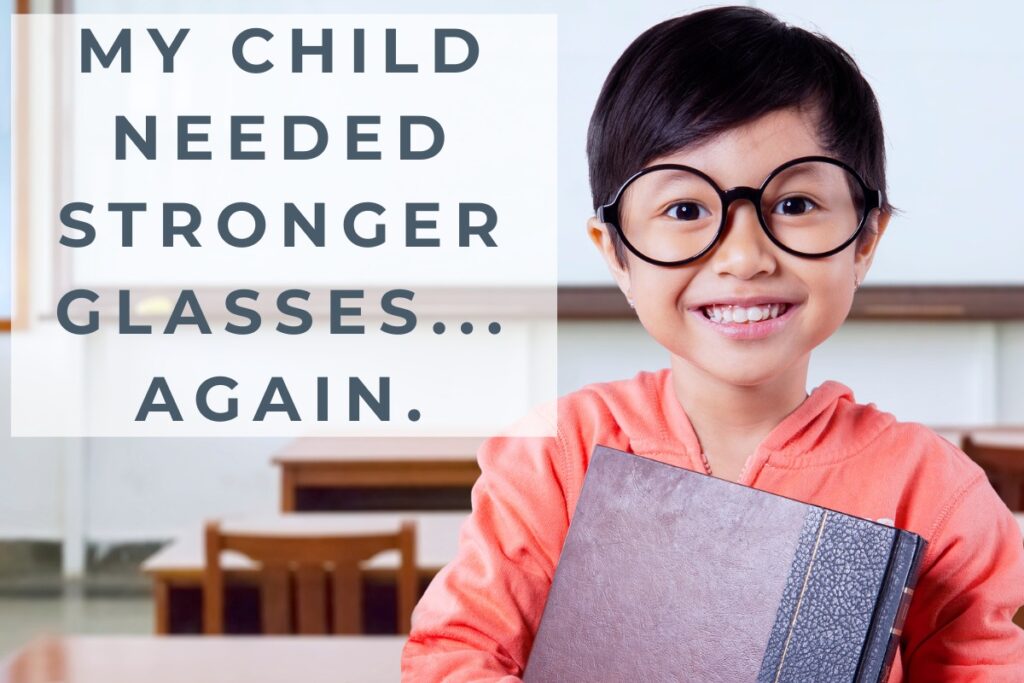
“I feel like we just got new glasses.”
It’s one of the most common things parents say during their child’s eye exam.
Last year, your child needed glasses.
This year, the prescription is stronger.
Next year it may change again.
Naturally, many parents start wondering:
Is this normal?
Will it keep getting worse?
Is there anything we can do to slow it down?
The answer is yes, a changing prescription is common during childhood, but it’s also something worth paying attention to.
Understanding Myopia
Myopia, also known as nearsightedness, occurs when the eye grows too long from front to back.
When this happens, light focuses in front of the retina rather than directly on it, causing distant objects to appear blurry.
Children with myopia may:
- Squint to see clearly
- Sit close to screens
- Move closer to the television
- Hold books very close
- Have difficulty seeing the board at school
- Complain of headaches or eye strain
Many parents assume myopia simply means their child needs stronger glasses.
However, there’s more to the story.
Why Does Myopia Usually Get Worse?
As children grow, their eyes grow too.
For some children, the eye grows faster or longer than it should.
When that happens, the prescription becomes more nearsighted.
This is why many children experience changes in their prescriptions throughout elementary, middle, and high school.
Some progression is common.
Rapid progression is what concerns eye care professionals.
Genetics Matter — but They Aren’t the Whole Story
If one parent is nearsighted, a child has a greater chance of becoming nearsighted.
If both parents are nearsighted, that risk increases even more.
But genetics don’t tell the entire story.
Researchers now believe environmental factors play an important role as well.
The Modern Childhood Environment
Today’s children spend more time focusing up close than any previous generation.
Homework. Tablets. Phones. Computers. Gaming systems.
While technology itself isn’t necessarily the enemy, prolonged near work combined with limited outdoor time appears to be associated with increased rates of myopia progression.
Multiple studies have found that children who spend more time outdoors may have a lower risk of developing myopia and may experience slower progression.
The exact reasons are still being studied, but natural light exposure appears to play an important role in healthy visual development.
Why Eye Doctors Are Paying More Attention to Myopia
Years ago, increasing prescriptions were often viewed as an inconvenience.
Today, we understand that higher levels of myopia may increase the risk of certain eye diseases later in life.
Higher amounts of myopia have been associated with increased risks of:
- Retinal detachment
- Myopic macular degeneration
- Glaucoma
- Cataracts
Not every child with myopia will develop these conditions.
However, reducing excessive eye growth may help reduce future risk.
This is one reason myopia management has become such an important topic in pediatric eye care.
Can Myopia Be Slowed Down?
One of the biggest misconceptions is that nothing can be done.
While we cannot completely stop the eye from growing, there are now evidence-based approaches designed to help slow progression in many children.
Depending on the child, options may include:
Specialized Contact Lenses
Certain soft contact lenses are specifically designed to help slow the progression of myopia while providing clear vision.
Specialized Eyeglass Lenses
Not every child is ready for contact lenses, which is why specialized myopia management glasses such as Stellest® lenses have become an exciting option. Unlike traditional glasses that simply correct blurry vision, Stellest® lenses are designed to both provide clear vision and help slow the progression of myopia.
Orthokeratology
Specialty lenses worn overnight can temporarily reshape the cornea and may help reduce progression in some patients.
Prescription Eye Drops
Low-dose atropine eye drops are sometimes used as part of a myopia management strategy.
Increased Outdoor Time
While outdoor time is not a replacement for treatment when treatment is needed, research continues to support the benefits of spending time outside.
The best approach depends on the child’s age, prescription, progression rate, lifestyle, and overall eye health.
How Do You Know If Your Child Is Progressing Too Quickly?
This is where routine eye examinations become important.
Many children adapt remarkably well to blurry vision and may not realize their vision has changed.
Some children continue to perform well in school despite significant increases in prescription.
Regular eye examinations allow us to monitor changes over time and identify concerning patterns before they become larger problems.
Questions Parents Should Ask
If your child’s prescription has increased recently, consider asking:
- How much did the prescription change?
- Is this amount of progression typical?
- What does the trend look like over time?
- Should we discuss myopia management options?
- Are there lifestyle changes that may help support healthy visual development?
The earlier the progression is identified, the more opportunities we may have to intervene.
The Bigger Goal
The goal isn’t simply to help children see the board at school.
The goal is to support lifelong eye health.
For many children, stronger glasses each year may seem like a normal part of growing up.
But understanding why it’s happening—and knowing what options exist—can help families make informed decisions about their child’s vision and future eye health.